Shoulder Replacement Surgery in Tyler, TX
When the cartilage in the shoulder is gone and every reach reminds you of it, replacing the worn surfaces is designed to give the joint a smooth glide again and may relieve much of that pain. Dr. David Kummerfeld, a fellowship-trained shoulder and elbow surgeon, performs anatomic, reverse, and revision shoulder replacement for patients from Tyler and across East Texas, including a subscapularis-sparing technique that many people know as the “slingless” shoulder replacement.
Signs the joint itself has become the problem
Replacement is almost never the first step. Most sore shoulders settle with a stretch of targeted therapy, a change in how the arm is used, or an injection, and Dr. Kummerfeld will walk through those options before talking about an implant. The conversation changes when the joint surface is what hurts. A shoulder that aches at rest, wakes you at night, grinds or catches when you raise the arm, and has stopped responding to the treatments that used to help often means the cartilage is worn through.
At that point the conversation often turns to which replacement would fit best. Dr. Kummerfeld answers that with your X-rays and, in most cases, a CT scan, and he goes over the images with you in the exam room so you can see what he sees.
Anatomic or reverse: how the choice is made
Every shoulder replacement swaps the worn ball and socket for smooth implant surfaces. The two designs differ in how they are arranged, and the deciding factor is almost always the rotator cuff. If the cuff still holds the ball centered and powers the arm, an anatomic replacement rebuilds the joint in its natural shape. If the cuff is torn beyond repair, a reverse replacement flips the geometry so the deltoid muscle can do the lifting instead.
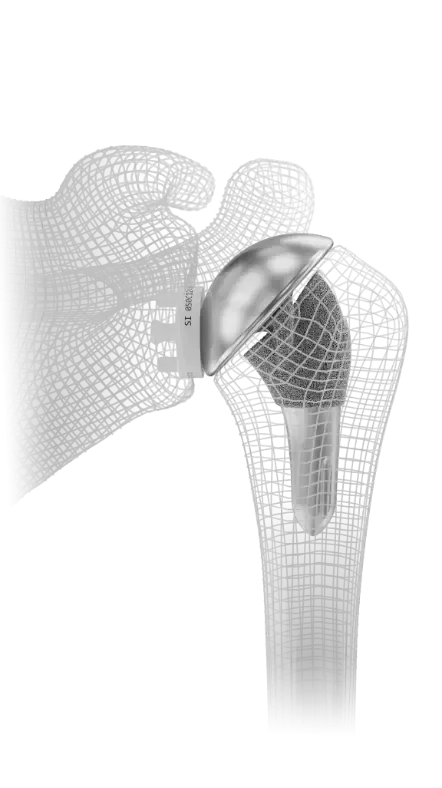
Total Shoulder Replacement
A polished metal ball replaces the top of the arm bone and a smooth socket component is fitted to the shoulder blade, preserving the joint’s normal layout. Best suited to osteoarthritis, inflammatory arthritis, and avascular necrosis in a shoulder with a working rotator cuff. Stemless and short-stem versions preserve more bone.
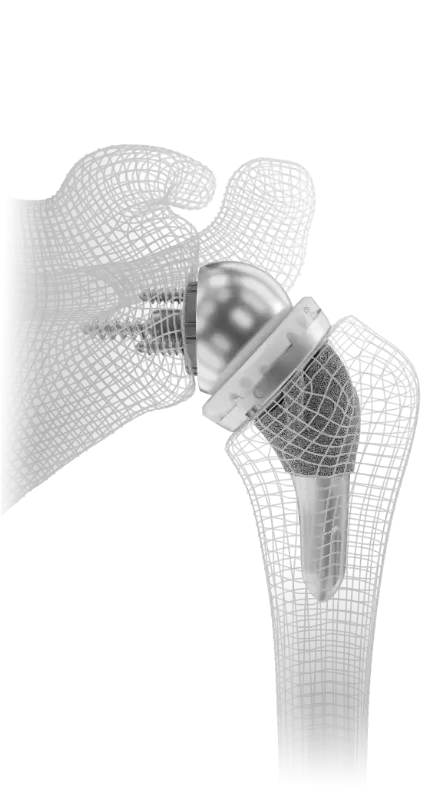
Reverse Shoulder Replacement
The ball is fixed to the shoulder blade and the socket sits on the arm bone. This is designed to let the deltoid lift the arm without a functioning rotator cuff. Used for cuff tear arthropathy, massive irreparable cuff tears, many complex fractures, and failed earlier surgery.
Already have a replacement that hurts, feels loose, or never worked the way you hoped? That is a different conversation, covered on the revision shoulder replacement page.
The "slingless" shoulder replacement
To reach the shoulder joint, a surgeon traditionally detaches the subscapularis, the large rotator cuff tendon at the front of the shoulder, and repairs it at the end of the operation. That repair has to heal before the arm can be used freely, which is why conventional recovery includes weeks of limits on reaching, pushing, and rotating the arm outward, and why a protected subscapularis is what therapists are guarding during that time.
Dr. Kummerfeld offers a subscapularis-sparing approach for appropriate anatomic and reverse replacements. He reaches the joint through the natural gap in the rotator cuff rather than cutting the tendon off the bone. Because nothing has to be repaired at the front of the shoulder, there is no reason to immobilize the arm: patients typically go home without a sling, may use the arm for light daily tasks right away, and start therapy with fewer restrictions. That is where the name comes from. The technique is not right for every shoulder. Significant deformity, bone loss, or scarring from prior surgery can make the standard approach the safer choice, and he will tell you plainly which one fits your anatomy.
Why Dr. Kummerfeld uses the InSet® Shoulder System
For both anatomic and reverse replacement, Dr. Kummerfeld uses the InSet® Shoulder System from Shoulder Innovations, a company that works only on the shoulder. Three design decisions shape how he plans and performs the operation.
A socket seated in bone, not on it
Rather than resting on the surface of the shoulder blade, the InSet® glenoid component is recessed into a prepared pocket in the bone, supported by the dense rim of the socket. Loosening of the socket component has historically been the most common reason an anatomic replacement needs to be redone, and seating the component within the bone is intended to resist the rocking forces that lead to it.
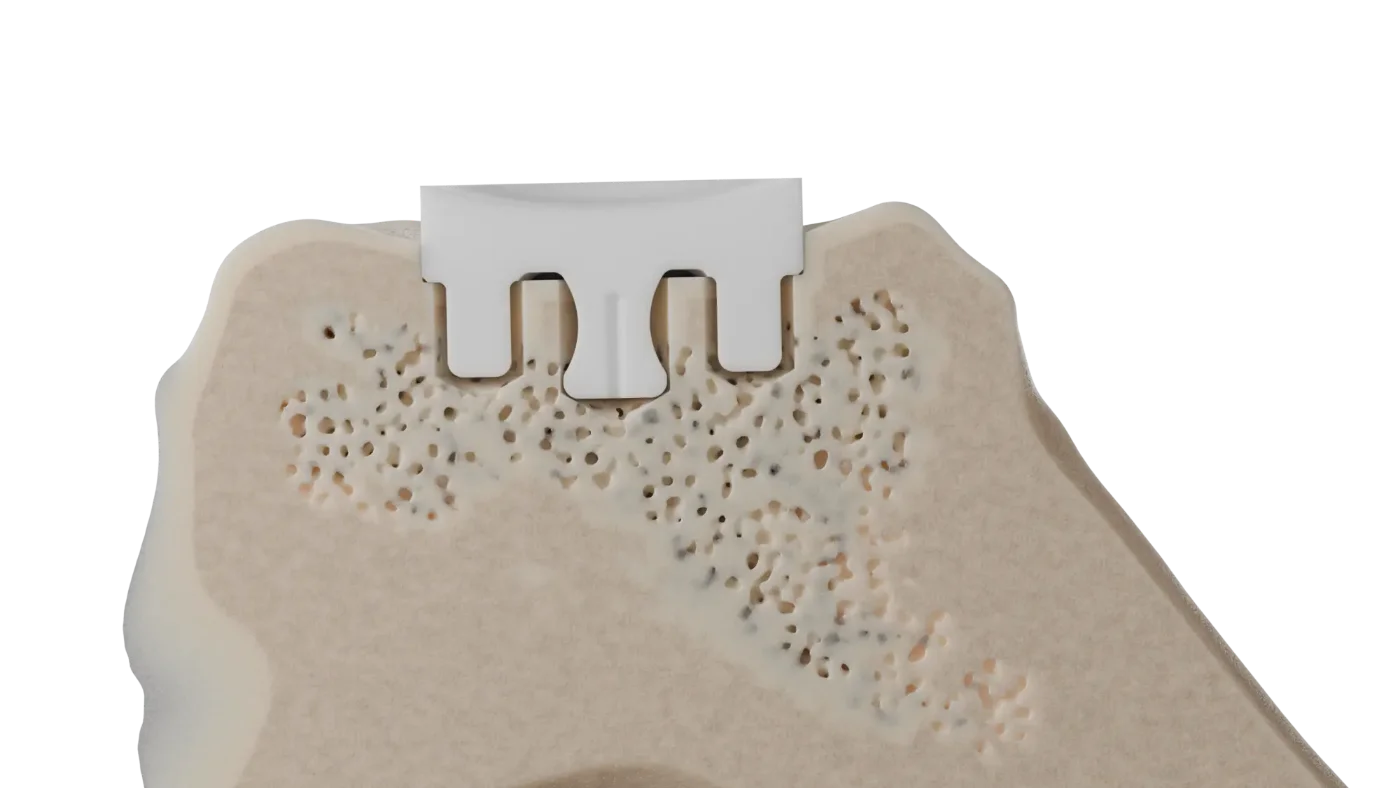
The InSet® glenoid recessed within the socket bone rather than perched on its surface.
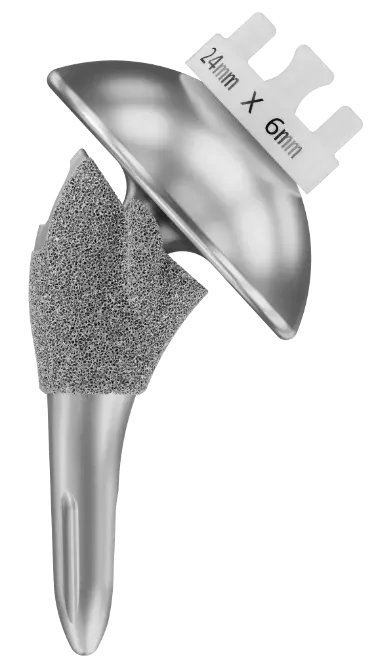
Stemless and short-stem humeral components keep more of your own bone.
Bone preserved for the future
The humeral side uses titanium components with a porous surface your bone can grow into, available in stemless and short-stem versions, and the system is built to remove as little bone as possible. For a younger or more active patient that matters: preserved bone keeps options open if the shoulder ever needs another operation, and a stemmed implant may be able to stay in place during a conversion to a reverse design.
Planned in 3D before surgery
Where the components sit has a great deal to do with how well a replacement works and how long it lasts. For most patients Dr. Kummerfeld builds a three-dimensional model of the shoulder from a CT scan and chooses implant size, angle, and depth on that model in advance, so the decisions are made on a precise copy of your anatomy rather than estimated in the operating room. Ask to see the plan at your pre-operative visit.
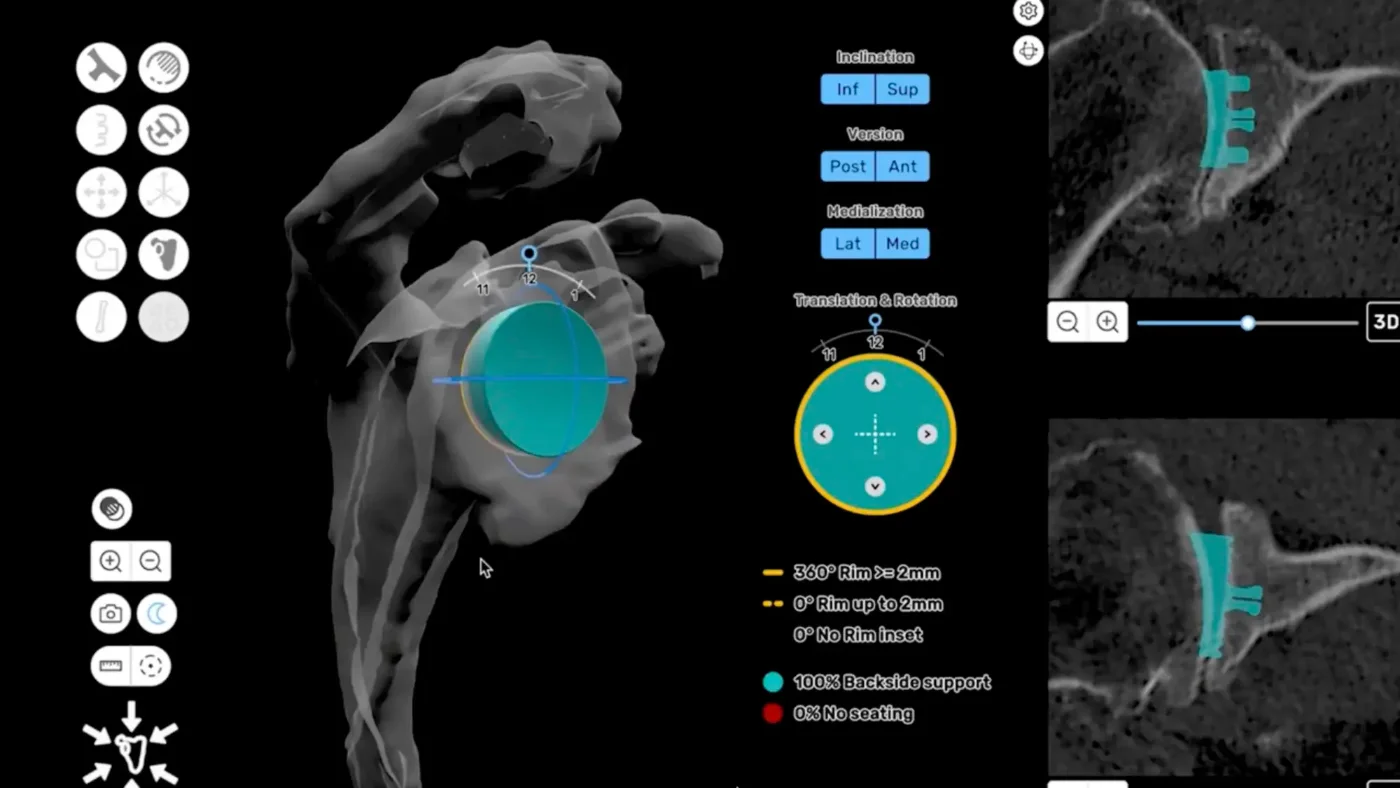
A CT-based plan sets implant size and position before the first incision.
From your first visit to full recovery
Your first visit covers your history, a hands-on exam, and X-rays. If replacement is on the table, a CT scan follows for planning, along with a pre-operative medical check. Surgery is performed at Baylor Scott & White Texas Spine & Joint Hospital in Tyler under general anesthesia, usually with a nerve block that keeps the shoulder comfortable well into the evening. The operation itself takes one to two hours. Many patients go home the same day; some stay one night depending on their health and the help they have at home.
The incision heals while you use the arm for light daily tasks such as eating, dressing, and typing, and begin gentle motion exercises. With the slingless approach there is no immobilization to work around.
Light use of the arm returns for meals, writing, and dressing as therapy restores range of motion.
Strengthening begins. Driving and most household tasks come back during this stretch.
Strength and stamina keep building. Golf, swimming, fishing, and gardening typically return in this window, with gains continuing up to a year.
Timelines are typical, not promised. Bone quality, tissue healing, general health, and how consistently you do your therapy all shape the pace.
Risks and what a new shoulder can and cannot do
Serious problems after shoulder replacement are uncommon, but every operation carries risk: anesthesia reactions, infection, bleeding, injury to nerves or blood vessels, stiffness, fracture, instability (a particular consideration with reverse designs), and wear or loosening of the implant over time that could require revision. Dr. Kummerfeld reviews the risks that apply to you, and protocols for antibiotics, blood clot prevention, and pre-operative optimization are in place to help keep them low.
A replaced shoulder is meant to hurt less and work better for daily life. It is not a return to the shoulder you had at twenty-five, and some lifting guidelines may be permanent, especially after a reverse replacement. He will be straightforward about what is realistic for your shoulder before you decide.
Questions patients ask
How long does a shoulder replacement last?
Published long-term studies report that many shoulder replacements are still working well beyond fifteen years. Longevity depends on the implant design, the stability of the socket component, bone quality, and activity level. A securely fixed socket is one reason Dr. Kummerfeld chose the InSet® system. Individual results vary.
Is there an age limit?
There is no strict cutoff in either direction. Younger, active patients are evaluated carefully because their implant needs to last longer, which is where a bone-preserving design helps. Symptoms, imaging, and goals matter more than your birth year.
Will I stay in the hospital?
Many healthy patients go home the same day from Texas Spine & Joint Hospital. Others stay one night. Dr. Kummerfeld recommends the setting based on your medical history and the support you have at home.
What is the "slingless" shoulder replacement?
It is a subscapularis-sparing approach in which the rotator cuff tendon at the front of the shoulder is left attached rather than detached and repaired. With no tendon repair to protect, most patients do not need a sling after surgery and may have fewer early restrictions. It is an option for both anatomic and reverse replacement when the anatomy allows.
How do I know whether I need anatomic or reverse?
It depends mainly on the condition of your rotator cuff and the shape of your socket bone. An exam and imaging give Dr. Kummerfeld what he needs to recommend the design that fits your shoulder, and he will explain the reasoning.
Find out where your shoulder stands
An evaluation with Dr. Kummerfeld gives you a clear picture of the joint and every option for treating it, surgical and nonsurgical. He sees patients at Azalea Orthopedics on South Broadway in Tyler.