Reverse Shoulder Replacement in Tyler, TX
For decades, patients with both arthritis and a rotator cuff that had failed had no good surgical answer: a standard replacement depends on the cuff, and theirs no longer worked. Reverse shoulder replacement changed that. Dr. David Kummerfeld performs reverse replacement with the InSet® Reverse Shoulder System for East Texas patients with cuff tear arthropathy, massive irreparable tears, complex fractures, and failed earlier surgery.
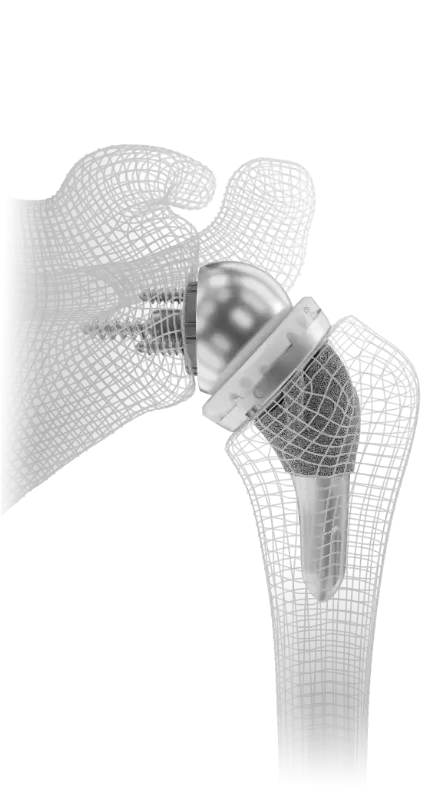
Why it is called a reverse replacement
In your natural shoulder the ball sits on the arm bone and the socket on the shoulder blade, and the rotator cuff holds the ball centered so the deltoid can lift the arm. When the cuff is torn beyond repair, the ball drifts upward, the deltoid loses its leverage, and the arm becomes weak and painful even if the joint surfaces themselves are not badly worn.
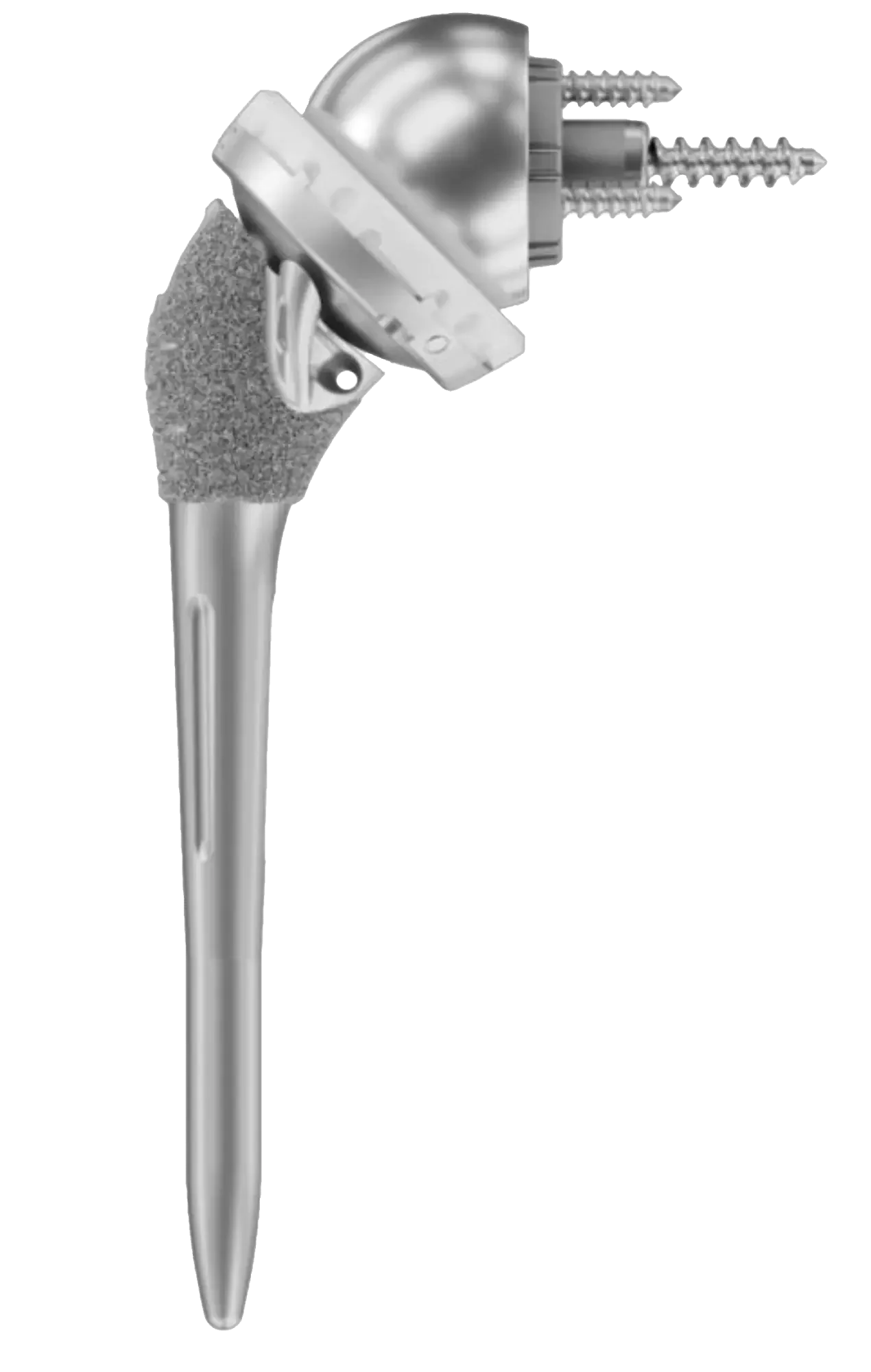
A reverse replacement flips the arrangement. A metal half-sphere is fixed to the shoulder blade and a cup-shaped component sits on top of the arm bone. That new geometry creates a fixed pivot point and lengthens the deltoid, so the one big muscle you still have may be able to raise the arm on its own. It is designed to restore motion even when the muscles that normally provide it no longer work, and it has become the most commonly performed type of shoulder replacement in the United States.
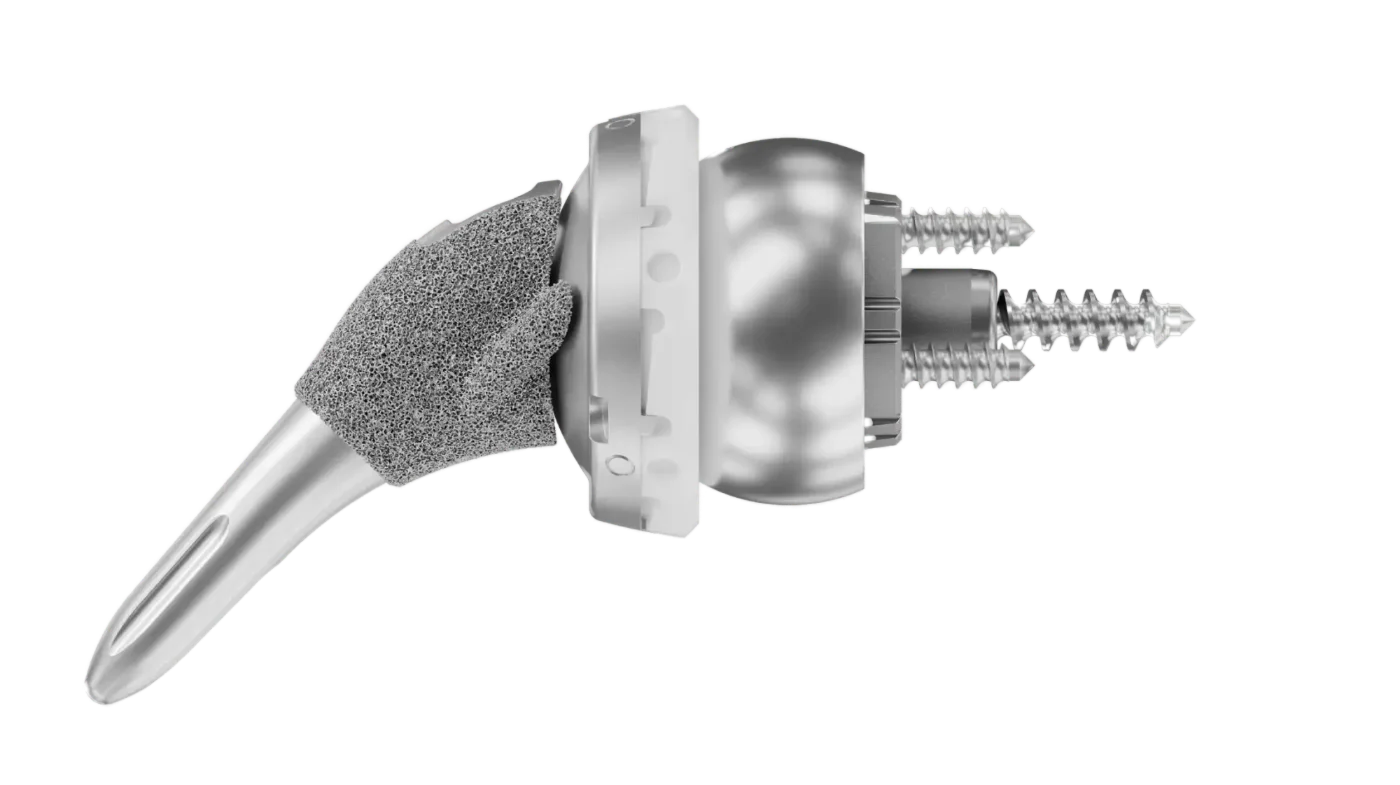
In a reverse replacement, the ball moves to the shoulder blade and the socket to the arm bone.
Conditions a reverse replacement treats
Reverse replacement is the right operation when the rotator cuff cannot be relied on, or when the socket bone will not support an anatomic component. Dr. Kummerfeld most often recommends it for:
- Rotator cuff tear arthropathy: the arthritis that develops after a large cuff tear has gone unrepaired for years, often with the ball riding up against the acromion
- Massive, irreparable rotator cuff tears with pain and loss of active motion, even without arthritis, including so-called pseudoparalysis, where the arm cannot be actively raised even though the joint itself is not stiff
- Complex fractures of the upper arm bone near the shoulder, particularly in older adults, when the pieces cannot be reliably fixed
- Severe arthritis with socket bone loss or deformity where an anatomic socket cannot be reliably supported
- Failed prior surgery, including a painful earlier replacement or a cuff repair that did not heal
For some younger patients with an irreparable tear but no arthritis, a joint-preserving tendon transfer may be considered before a reverse replacement. Dr. Kummerfeld will explain which fits your shoulder and your goals.
The InSet® Reverse Shoulder System
Dr. Kummerfeld performs reverse replacement using the InSet® reverse system from Shoulder Innovations. Two aspects of the system shape how he plans and performs the operation.
Bone preservation
The humeral component is a titanium stem with curved fins and a porous coating designed to encourage your bone to grow into it, and the glenoid baseplate comes in configurations chosen to limit how much bone must be removed to seat it securely. Bone kept in reserve matters most to the patient you will be fifteen or twenty years from now: if a revision is ever needed, preserved bone is what gives that surgeon good options.
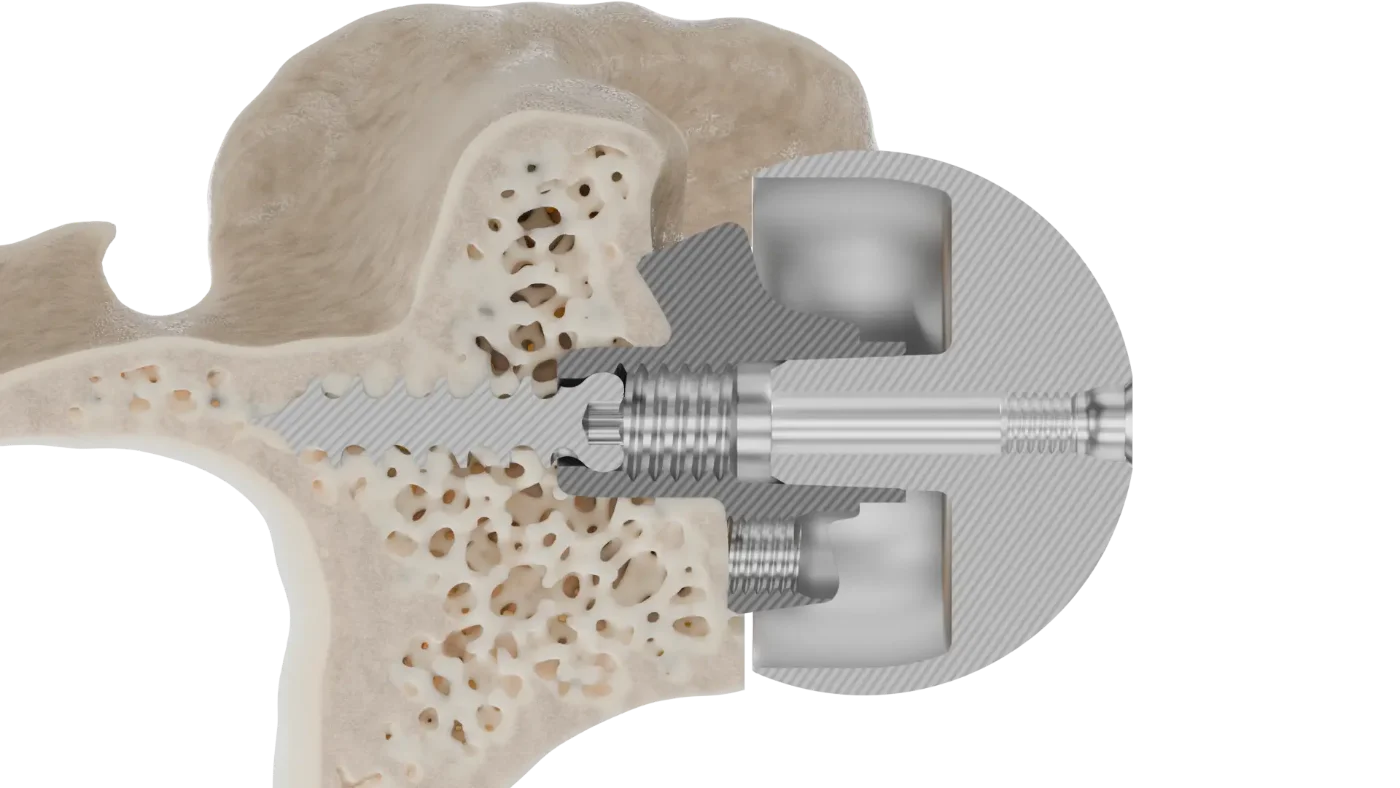
The reverse baseplate seated in the socket bone.
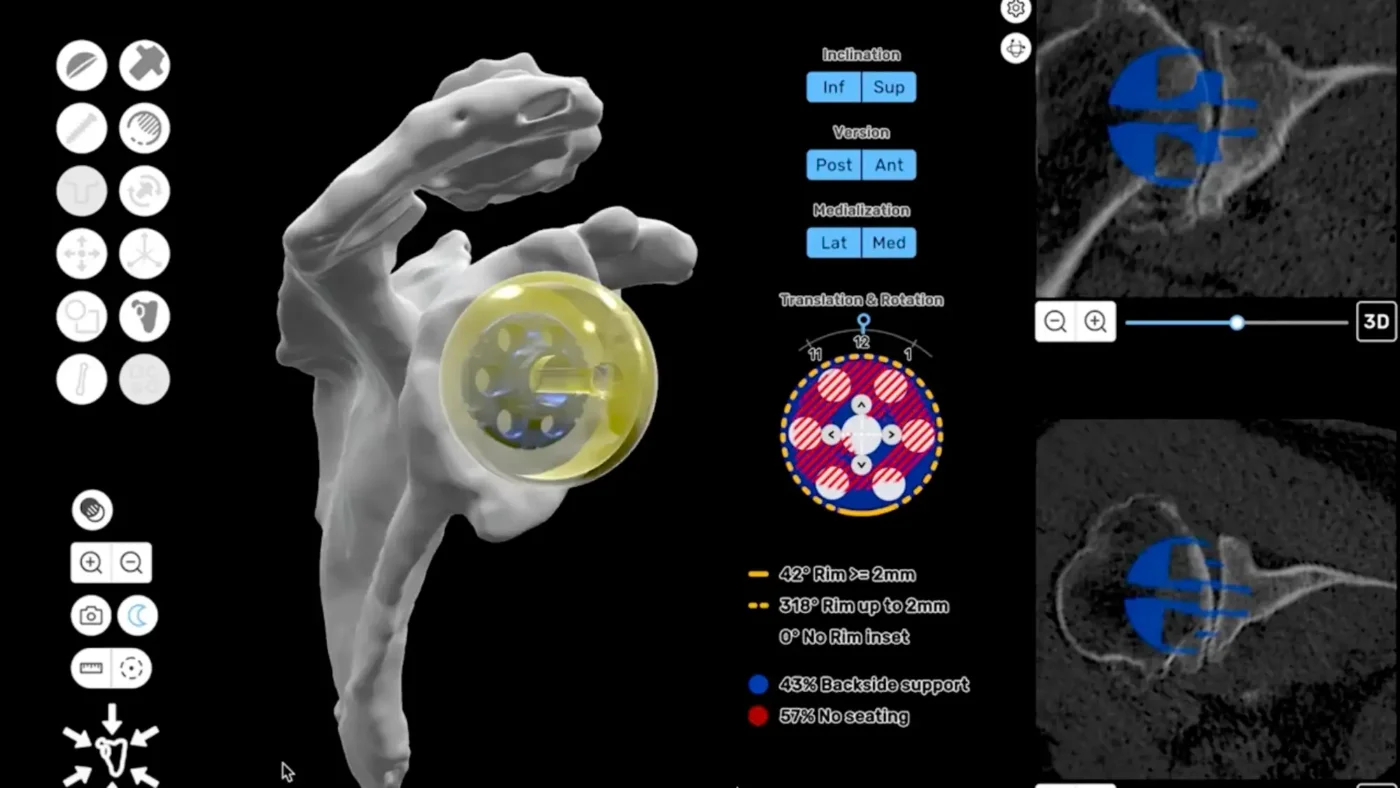
3D planning of component position from a CT scan.
Planning
In a reverse replacement, where the components sit determines how far the arm can move and how stable the joint is. Dr. Kummerfeld maps each case in advance on a three-dimensional model built from your CT scan, choosing implant size and position on a precise copy of your anatomy rather than estimating in the operating room.
Subscapularis-sparing reverse replacement
Because a reverse replacement does not rely on the rotator cuff, surgeons have long debated whether the subscapularis tendon at the front of the shoulder should be repaired at all. Dr. Kummerfeld takes a different route when the anatomy allows: he leaves the tendon attached and reaches the joint through the natural interval above it, the same “slingless” approach he uses for anatomic replacement. With nothing to repair at the front of the shoulder, there is no need to immobilize the arm, so most patients go home without a sling and early motion may be more liberal. Deformity, bone loss, and prior surgery can make a traditional exposure the safer choice, and he decides that from your CT scan and exam.
Reverse replacement for a broken shoulder
A badly broken upper arm bone near the shoulder can be hard to fix with plates and screws, especially in older adults with thinner bone, where the pieces may not hold or the ball may lose its blood supply. In those cases, a reverse replacement is often the more predictable option: the damaged ball is replaced outright, the tuberosities that anchor the rotator cuff are secured around the stem, and the design is meant to let the deltoid power the arm even if those fragments do not heal perfectly. Dr. Kummerfeld evaluates each fracture individually, and many are still best treated with repair or even without surgery.
What to expect
The operation typically takes one to two hours under general anesthesia with a regional nerve block, performed at Baylor Scott & White Texas Spine & Joint Hospital in Tyler. Working from the pre-operative plan, Dr. Kummerfeld rebuilds the joint through a single incision at the front of the shoulder. Many patients go home the same day or after one night.
Reverse replacement recoveries are often more comfortable early on than patients expect, partly because the arthritis pain is addressed at its source. A typical progression:
You use the arm for light daily tasks while the incision heals and begin gentle motion exercises. Many patients notice the deep ache begins to ease early.
Therapy focuses on restoring motion, especially reaching forward and overhead, and the arm is used more freely for daily activities.
Deltoid strengthening begins. Reaching a shelf, sleeping on the side, and lifting light objects become easier.
Function keeps improving for most of a year. Golf, swimming, gardening, and travel typically return, within some permanent guidelines about heavy or repetitive lifting.
Reaching behind the back and rotating the arm outward may remain more limited after a reverse replacement than after an anatomic one. For patients with a specific weakness pattern, Dr. Kummerfeld may discuss combining the replacement with a tendon transfer to improve rotation.
Risks to consider
Reverse shoulder replacement has a well-established track record, and long-term studies have reported durable improvement in overhead function for many patients with massive cuff tears, with or without arthritis. Complications are uncommon but possible. Dislocation is the one most specific to the reverse design; depending on the cause, it may be treated with a closed reduction or may require surgery to adjust the implant. Other risks mirror joint replacement in general: anesthesia reactions, infection, nerve or blood vessel injury, fracture of the arm bone or the shoulder blade, blood clots, and implant wear or loosening over time that could require revision. Dr. Kummerfeld reviews the risks that apply to you before you decide. Results vary.
Questions patients ask
Can a reverse replacement fix my rotator cuff tear?
It does not repair the torn tendons. Instead it changes the mechanics of the joint so the shoulder no longer depends on them. For many irreparable tears, that may make it a more reliable option than attempting a repair that is unlikely to heal.
Why would I need a reverse instead of a standard replacement?
A standard anatomic replacement depends on a healthy rotator cuff. If your cuff is badly torn or no longer works, or if your socket bone cannot support an anatomic component, a reverse design is meant to work around the problem. Your exam and imaging tell Dr. Kummerfeld which situation you are in.
Will I be able to lift my arm overhead?
For many patients with cuff tear arthropathy or a massive tear, restoring the ability to raise the arm is the main reason to do the surgery, and it is where reverse replacement tends to perform best. Rotation outward and behind the back may stay more limited, which is why a careful exam of your remaining cuff matters.
Are there permanent restrictions?
Most patients are given sensible lifelong guidelines about very heavy or repetitive overhead lifting to protect the implant. Daily life, recreation, and travel are generally not restricted once you have recovered.
Can the "slingless" approach be used for a reverse replacement?
Yes, when the anatomy allows. Leaving the subscapularis attached means there is no front-of-shoulder repair to protect early on and no sling is needed. Dr. Kummerfeld decides from your imaging whether it is appropriate for your shoulder.
Find out whether reverse replacement fits your shoulder
If you have been told your problem involves both the joint and the rotator cuff, an evaluation with Dr. Kummerfeld will clarify your options. He sees patients at Azalea Orthopedics on South Broadway in Tyler.