Shoulder Instability & Labral Repair in Tyler, TX
A shoulder that slips, dislocates, or feels like it could give way sidelines athletes, tradespeople, and weekend warriors alike. Dr. David Kummerfeld treats shoulder instability and labral tears with arthroscopic labral repair and, when repeated dislocations have worn away part of the socket, arthroscopic anatomic glenoid reconstruction (AAGR), a bone-grafting technique that rebuilds the socket through small incisions.
What a dislocation does to the shoulder
The shoulder trades stability for motion. A rim of cartilage called the labrum deepens the shallow socket and anchors the ligaments that hold the ball in place. When the shoulder dislocates, the labrum tears away from the bone (a Bankart lesion) and the ligaments stretch. Each additional dislocation can chip or wear away more of the front of the socket, so the next one takes less force. Younger patients, contact athletes, and anyone with bone loss are the most likely to keep dislocating without treatment.
Signs include a shoulder that has come out or partially slipped, a feeling of looseness or a “dead arm” with overhead or throwing motions, apprehension when the arm is raised and turned outward, and clicking or deep pain from the torn labrum.
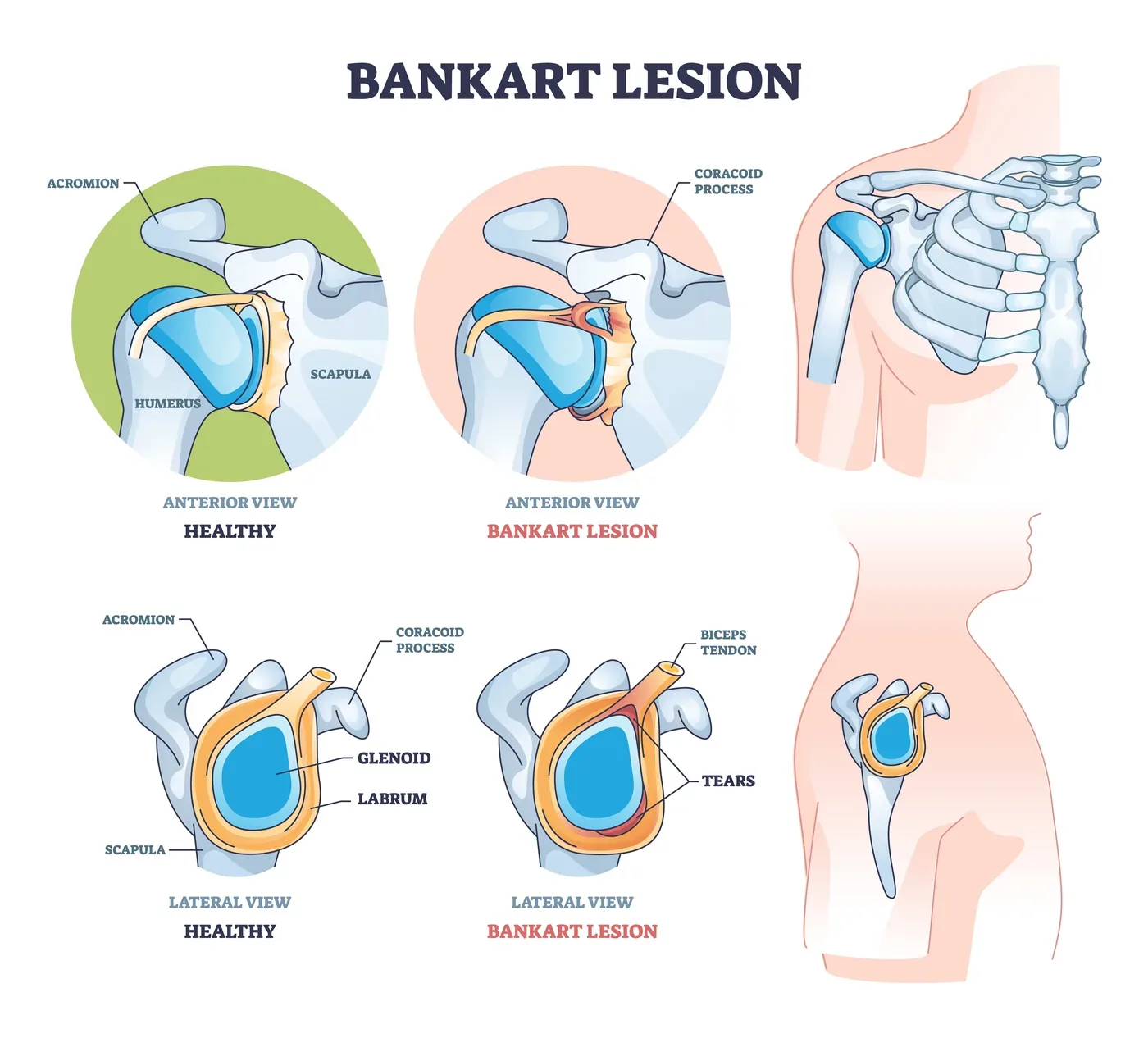
A Bankart lesion: the labrum torn from the front of the socket.
From rehabilitation to rebuilding the socket
The plan depends on how many times the shoulder has dislocated, what you do with it, and above all how much bone is missing from the socket, which Dr. Kummerfeld measures on a CT scan.
Strengthening the rotator cuff and shoulder blade muscles can be enough after a first dislocation in a lower-demand patient, and it is the first step for looseness in more than one direction.
The torn labrum is reattached to the socket rim with small anchors and stretched ligaments are tightened. This is the standard operation when the socket bone is intact.
When repeated dislocations have worn away the front of the socket, a soft tissue repair alone is likely to fail. A bone graft shaped to the missing area is fixed to the socket through small incisions, restoring its width and contour while preserving the surrounding muscles.
Tears at the top or back of the labrum, common in throwers and lifters, may be repaired or treated with a biceps procedure depending on age and activity.
Recurrent instability after an earlier surgery often means unrecognized bone loss and often needs reconstruction rather than another soft tissue repair.
Returning to work and sport
A sling protects the repair or graft for several weeks. Therapy restores motion first, then rebuilds the cuff and shoulder blade strength that provides dynamic stability. Return to contact and overhead sports is usually considered around four to six months based on strength testing, not the calendar. Risks include recurrence, stiffness, infection, nerve injury, and, with bone grafting, graft healing problems. Dr. Kummerfeld will tell you which procedure your shoulder actually needs and what the return-to-play timeline looks like for your sport.
Get back to a shoulder you can trust
If your shoulder has dislocated more than once or still feels loose after a prior surgery, a CT-based evaluation with Dr. Kummerfeld will show whether bone loss is the reason.