Revision Shoulder Replacement in Tyler, TX
Many shoulder replacements work well for years. When one does not, because of pain, loosening, instability, infection, or a rotator cuff that has failed around it, the answer is rarely a simple repeat of the first operation. Revision surgery starts with finding out why the replacement failed. Dr. David Kummerfeld, fellowship trained in complex shoulder reconstruction, evaluates and revises shoulder replacements performed anywhere.
Common reasons a shoulder replacement stops working
A replacement that hurts or never worked as expected is discouraging, especially after you have already been through surgery and months of recovery. The causes fall into a handful of patterns, and each one points to a different fix:
- Socket loosening, the most common long-term problem after anatomic replacement, often felt as a return of deep pain and a loss of motion
- Rotator cuff failure after an anatomic replacement, which lets the ball ride upward and leaves the arm weak
- Instability or dislocation, more often seen with reverse designs
- Infection, which can be subtle, developing months or years later with little more than persistent ache and stiffness
- Fracture around the implant after a fall
- Stiffness or unexplained pain despite normal-looking X-rays
Diagnosis before any decision about surgery
Dr. Kummerfeld treats a painful replacement as a diagnostic problem first. X-rays and a CT scan show implant position, loosening, and how much bone remains. Blood work and, when needed, a joint aspiration screen for low-grade infection, which must be ruled out before any revision is planned because it changes the entire approach. He also asks for the operative report and implant records from your first surgery so he knows exactly what is in the shoulder. Only once the cause is clear does the conversation turn to what, if anything, should be done about it. Some patients are best served by continued observation, and he will say so.
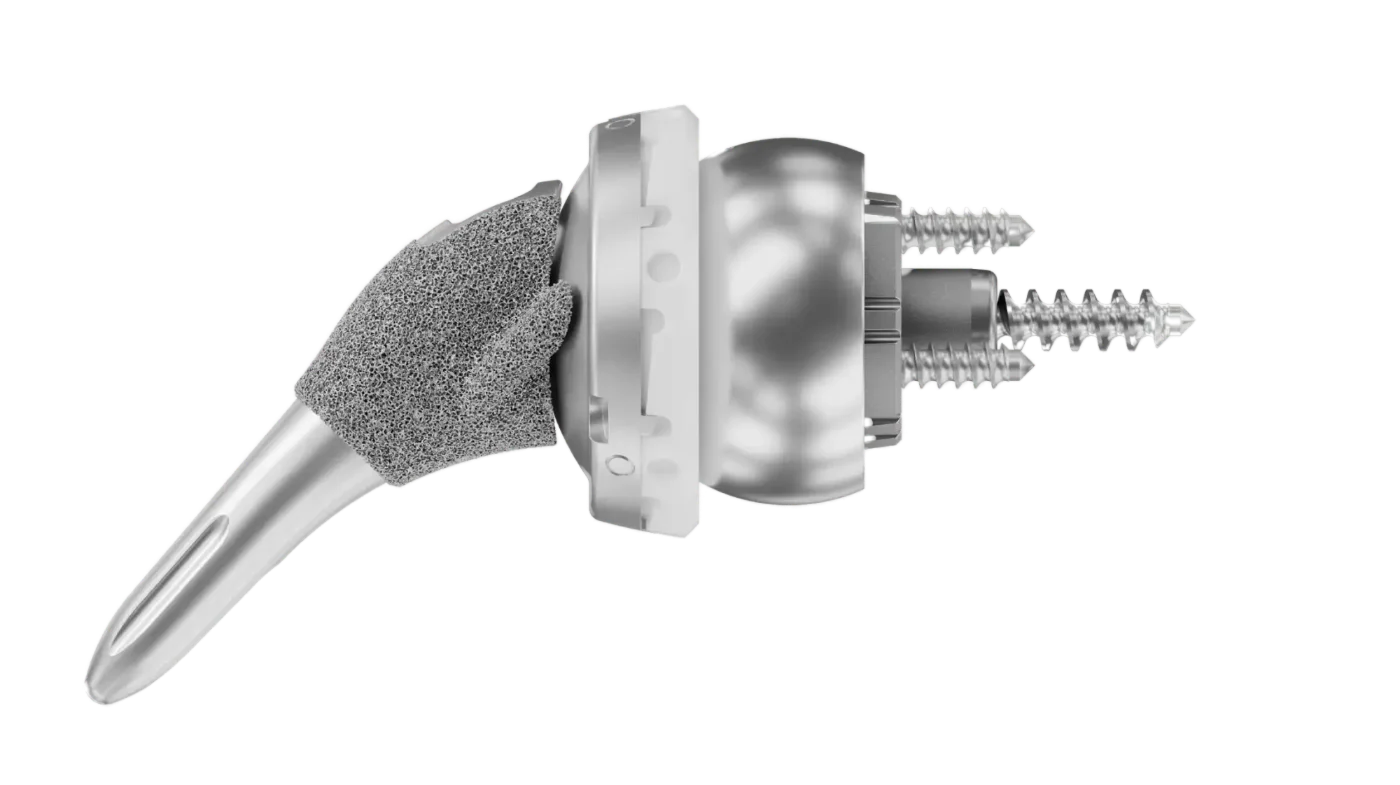
A reverse configuration is the most common outcome of a revision.
How a failed replacement is rebuilt
Revision is tailored to what the workup finds. Some patients need only one component exchanged. More often, a failed anatomic replacement is converted to a reverse replacement, which does not depend on the rotator cuff and tolerates socket bone loss better. When bone has been lost, it may be rebuilt with graft or with specialized augmented components. When infection is present, treatment is usually staged: the implant is removed and an antibiotic spacer placed, a course of antibiotics follows, and a new implant goes in once the infection has cleared.
Bone-conserving first replacements make all of this easier, which is one reason Dr. Kummerfeld favors the InSet® system for primary surgery: a humeral stem that preserved bone the first time can sometimes be kept in place and converted rather than removed.
Recovery and realistic goals
Revision surgery is more complex than a first replacement, operating time is longer, and recovery can take longer too. The early protection and therapy progression are similar to a primary reverse replacement, but the starting point is a shoulder that has already been through one operation, so gains come more gradually. The goals are relief from the pain that brought you in and a shoulder you can use for daily life; a revised shoulder rarely matches a well-functioning first replacement, and Dr. Kummerfeld will be clear about what is achievable. Risks include those of any replacement plus a higher chance of infection, fracture, nerve injury, and instability.
Not sure what is wrong with your shoulder replacement?
If your replacement was done elsewhere and still hurts, feels unstable, or never worked the way you expected, bring your X-rays, any CT or MRI reports, and your operative notes. Dr. Kummerfeld will review everything with you and lay out the options, including when leaving things alone is the better choice.
Questions patients ask
My replacement was done by another surgeon. Can Dr. Kummerfeld still evaluate it?
Yes. He regularly sees patients whose first replacement was performed elsewhere. Operative notes and implant records help, but he can begin the workup without them.
How do you know if a replacement is infected?
Low-grade infection can be subtle. Blood tests and a joint aspiration, in which fluid is drawn from the shoulder and cultured, are the standard way to check, and they are done before any revision is planned.
Will I need to go through the whole recovery again?
Recovery after revision generally follows the same phases as a primary replacement, with a period of protection early and progressive therapy afterward, but it often takes longer and the gains are more gradual.
Is revision always a reverse replacement?
Not always, but conversion to a reverse design is the most common outcome because it does not depend on the rotator cuff and handles socket bone loss well. Some patients need only a single component exchanged.
Get answers about a painful shoulder replacement
Request an appointment online or call the office in Tyler. Bring your imaging and operative records if you have them.